Puebla,Mexico was the scene of one of the most interesting projects I was involved with. Richard (not his real name) and myself had been sent to appraise a factory – a potential purchase to facilitate the launch of our best selling product.Dick was the engineer, I was the business lead – 8 days to come up with a feasibility assessment, outline design and cost. Dick had some interesting personal characteristics – believed the world centered around engineers , quite an ego, very status conscious and didn’t take advice readily. Day 1, not a seasoned business traveller,Dick insisted on having his normal breakfast – cornflakes. Strongly counselled not to do this – raw milk likely to be problematic ( the rules of CB, my mentor being – no ice; bottled water only; nothing cold, no salads or cold cuts; eat hot local food;drink beer – all lost on Dick) – Dick went ahead. 6 miserable days spent with food poisoning in a hotel room meant I had to be both engineer ( with the help of a local contractor) and business lead. A pleasing result for me, the factory was bought, the manufacturing facilities installed as designed and the execution cost within 30% of estimate. For Dick – cornflakes!

Thus doing a garden project especially with plenty of planning time did not seem to be too big a risk – but this project would be very personal. With summer upon us and very much in maintenance mode now is a good time to review how it all went.

Big picture summary – a success. On budget with scope delivered – hitting all the elements we wanted. The time taken in selecting the design and installation partners – well spent. So what were the key points to note.

The big money was in the hardscaping, fencing and mature trees. The quality of the trees was impressive and the care taken in planting has contributed to them thriving – early days but no signs of stress. The fencing was simple – the design type was controlled by the HOA – all vendors offered similar materials so it was simply choosing a vendor you can work with and then negotiating hard. The choice of patio was frustrating – Covid supply chain issues limiting choice with our preferred being unavailable. In the end CP chose the shade and we went with the only product that was available – a blessing in disguise as there was much less angst and we are happy with the outcome.

Plant selection took up a lot of time – much of it wasted as many selections were not available. I came to realize that there is a difference between a landscape architecture company and a garden design company. Scale is one difference but also planting philosophy is another. LA’s tend to focus on multiple plantings of few species with green being the common color and height and texture the differentiators. Color is more of a challenge and I was surprised at the narrow focus of recommendations and limited choice in the supply base. Once the perennial beds had been planted I managed to find a greater range of plants myself to fill in the gaps – a process that will continue. To date, the only perennial that has under performed is Stokes aster – a dozen were planted and are likely candidates for replacement next spring.

The crevice garden installation and design turned out 100% as anticipated and has surpassed all expectations. The weeks that CP and Mads spent with me defining the exact positioning of the installation was perhaps the most important aspect of the design.With no help from the topography we think its position is the perfect balance as both a focal point in its own right and a punctuation mark between the herbaceous beds and the Japanese garden. Stone selection was brilliant and Jeremy and Megan excelled. A surprise in the crevice garden has been the lack of resilience with the planting. I chose the plants that performed best in the Ridge crevice gardens and replicated them at AndAllen – a bit further south, a bit hotter and more humid.At time of writing it looks as if about a dozen have bitten the dust – will get a better estimate next Spring but it looks like the bedrock planting will evolve to sedum and delosperma – both doing well.

The woodland walk is definitely work in progress but there is no doubt that a good framework has been established. The preparation of clearing out trash trees and scrub paid dividends as the path installation and shrub backbone looks promising. The plan was to blend the natural with the cultivated – the surprise has been how little natural has surfaced in this growing season. Mayapple were impressive and ferns whist sparse will do well and I can safely install more natural varieties. The challenge for the fall is to continue to fill out the understory layer with natural drought resilient shrubs.

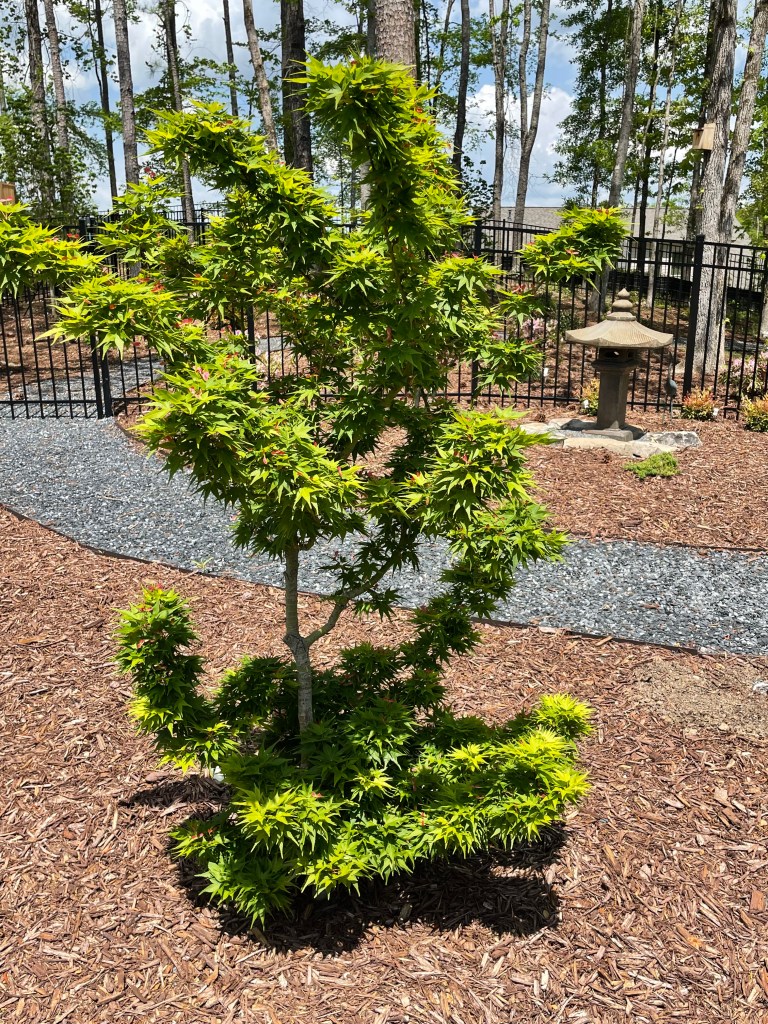
The Japanese garden is looking good – a great selection of dwarf acers planted and so far they look to be surviving the heat.All have put on a few inches of growth and there individual profiles are looking very interesting.
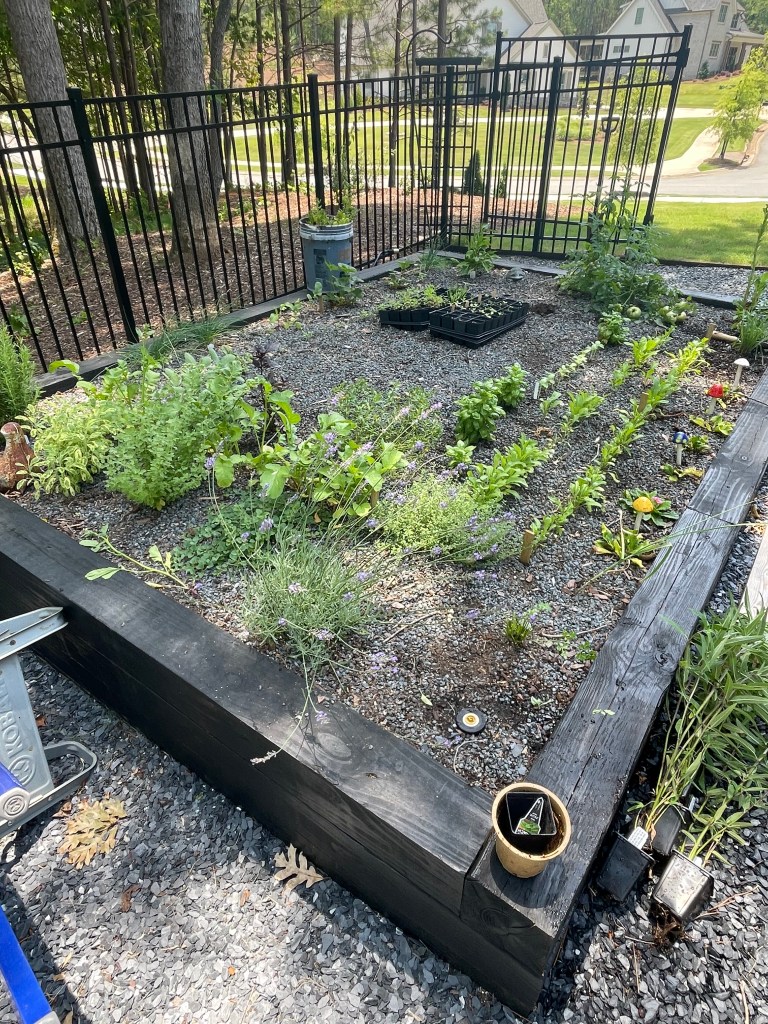
The raised bed herb garden has had no planting strategy – herbs just thrown in here and then. Tomatoes and peppers have been productive and there has been a continuous supply of lettuce. Most of the herbs have done well – need to plant more parsley and cilantro from seed – basil has done well from both seed and potted plants. Radishes have not performed at all. It has been good fun.
Due to the timing of the garden’s development there is one significant element that has yet to be installed. Autumn planting of bulbs is planned for the front ”yellow bed” , herbaceous beds, crevice garden and woodland walk. Camassia, allium ,narcissi, anenome are amongst those that have proven themselves in southern climes.

Reviewing important and interesting things in your life is a worthwhile exercise. On one point it enlightens you to both achievements and lost opportunities as well as providing a realistic baseline for future plans. We are both amazed at how much we have achieved in a few months and are looking forward to the return of the cooler weather to get cracking again.
 AndAllenGarden