Pub Quiz and Tools!

During the height of the pandemic in 2020, RollsRoyceGuy and his wonderful wife, Fi, had the idea of keeping our circle of friends amused by hosting a virtual pub quiz.Great success! However,an opportunity was lost as this could have been the next big reality TV program as lock down cabin fever brought out a range of competitive behaviors. A psychologists dream! For most though, the main objective was not to win the wooden spoon.

My favorite was the picture round – with the ”show us your favorite gadget”episode being outstanding. The males had to anonymously show their favorite gadget and the females had to guess who was its owner. Points won or lost for correct/incorrect answers. A strawberry huller was my selection.
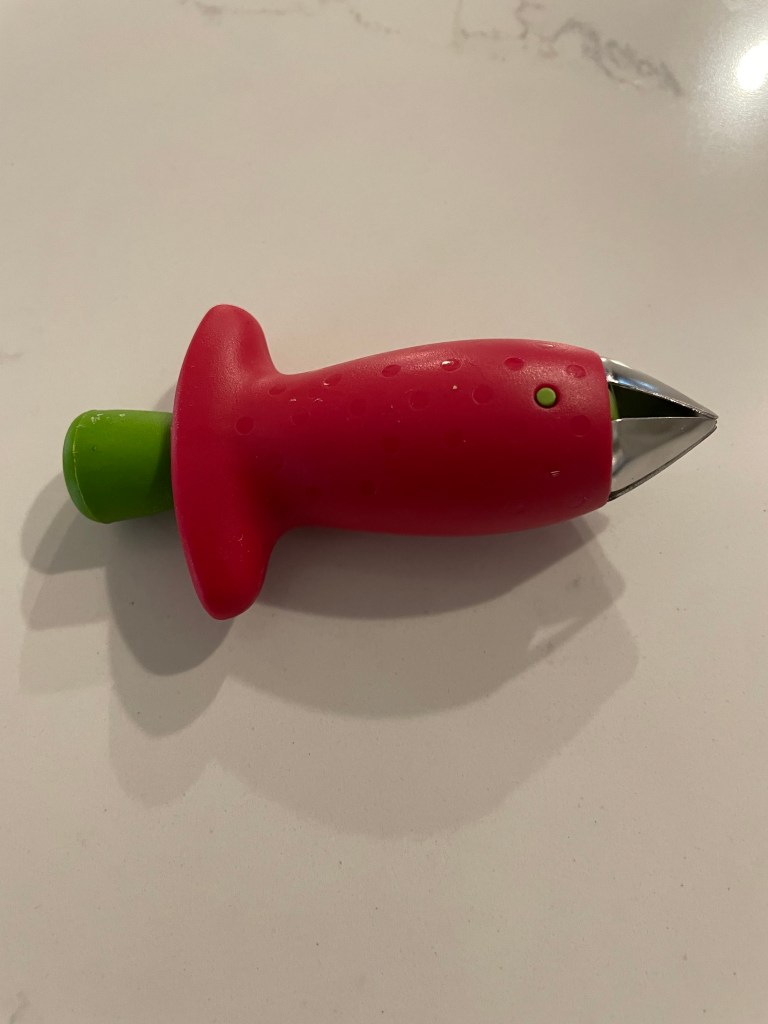
Cob and AL both know how strawberries grow as they have seen them in their raised bed. Rosie thinks they magically come from the fridge fairy- so our raised bed will have strawberry plants and maybe she will get to use the huller?

But not to waste a good idea, I thought I would share 2 of my favorite gardening tools. Part of making gardening fun is to try and take the hard graft out of it, especially stressful back bending work. Both the dutch hoe and wrecking bar do this.
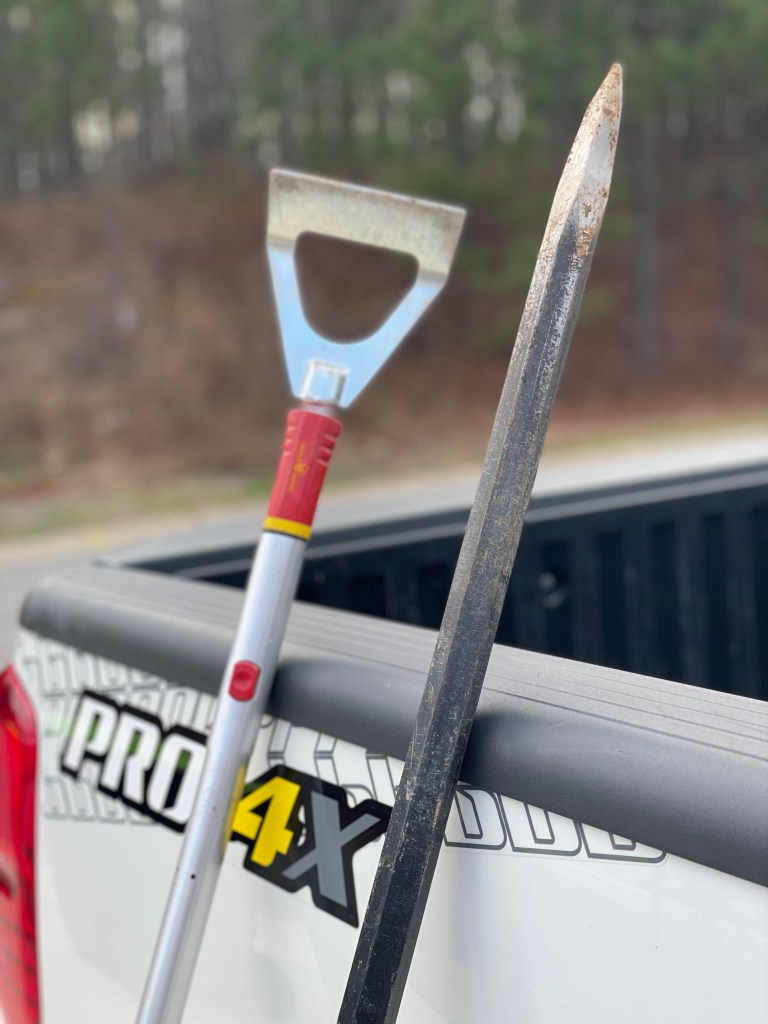
Dutch hoe (L); Wrecking bar(R)

The wrecking bar is used in all kinds of construction work – Jeremy uses one to build crevice gardens. I have used one for 20 years – to plant bulbs. The pointed end of this heavy, 5’ bar when driven into the ground and wiggled around, leaves a nice bulb size hole about 6” deep – perfect! Next autumn mine will be called into action to plant narcissi, allium and camassia.

I learned to use a dutch hoe at Andy’s allotment before I was 10 – weeding between rows of spuds and brassicas. In half an hour it is possible to clear a pretty big patch of all kinds of emerging weeds. All done without the slightest back bend.

It has been a good while since I worked long stints in the garden during winter and as such at the end of the day a good bath is in order. lrene was fond of lavender bath salts……so……..

The wonderful smell of lavender!

I have not been successful in growing lavender (English or French) since coming to the US – too much clay, preventing good drainage and wet roots does it for lavender. So, with the use of a gravelly landscape mix in the raised bed I think it worth another try. Something to look forward to.

Week 2 Progress

Week ending 21st Jan 2022 was a short week – Monday, we celebrated the life of MLK ; Thursday was characterized by ice cold rain.Nontheless,the team made good progress.

Irrigation revamp

After a lot of consideration, we decided to do a major upgrade to the irrigation system.Even though the system was only 5 months old there had been valve failures and leaks.Good progress has been made,trenches dug,pipes laid,valves installed.

Herbaceous border – in progress

The herbaceous border – a 12” cavity in the ground to be filled with CLM. A couple of mechanical diggers and great work ethic got us 90% finished.The excavated soil was not as clay(ee) as anticipated.

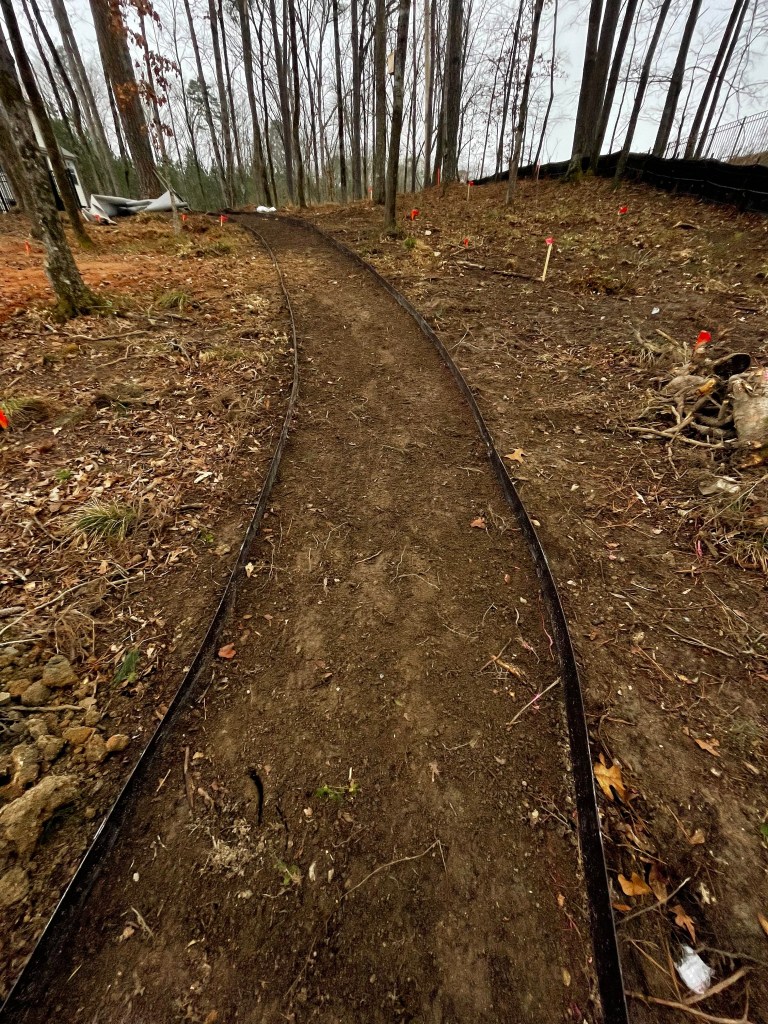
The woodland path

The location of the woodland path had been in place for weeks – designated by blue flags.The metal edging is now in place and the walkway smoothed out. The work completed behind this simplistic profile is considerable – remove leaves,dig out roots,grading – all before the edging is positioned.

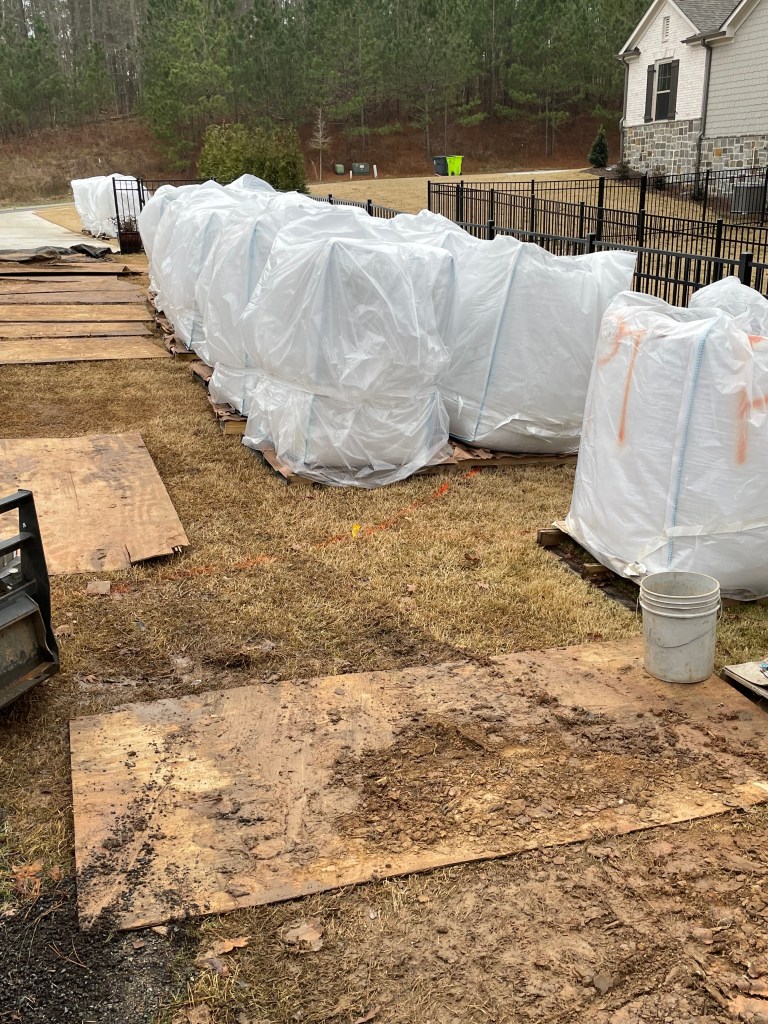
40 cu yd of CLM delivered

A big decision was to replace the soil in the herbaceous border.A couple of weeks of analysis to decide the composition of the replacement mix, a couple of days to blend the mix, and a couple of hours to off load it. Getting it in place will be an interesting process.

To keep myself busy, I tidied up the woodland garden;recycled displaced soil to finish off an existing pathway and spent considerable time working on the planting of the herbaceous border.

A nice week.

Swedes 2 Turnips 1

A cold winters day, waking up to frost all over the windscreen of the truck. An inconvenience, but frost always reminds me of Andy talking about the need to leave your turnips in the ground until the first frost – improves the flavor. The turnip is one of my favorite winter vegetables.

The humble turnip.

In England, the turnip was grown sporadically in the 1700’s mainly as animal fodder,but the invention of the seed drill by Jethro Tull* modernized agriculture and turnips were efficiently crop rotated with cereals. Consequently, the turnip was popularised.

Now, the yellow fleshed vegetable that,in the north of England, we call a turnip is called a swede in the south of England.Down south, turnips are smaller white fleshed vegetables that have a characteristically stronger flavor – in the north, logically , we call these white turnips! Turnips in Scotland are referred to as neeps (from the latin name, B. napus) and are one of the traditional accompaniments to the national dish,haggis.

Surprise upon surprise. When we came to the US we realized that turnips were called rutabaga. I had no idea why until my good friend Udo,from Germany, also a fan of this vegetable, told me that the name is Swedish in origin, where it is called rotabagge (apparently translated as red bag). Turnips originated in northern Europe before spreading wordwide – makes sense,I guess.

Turnips – yellow and white

Now to the headline! In 1992 ,at the European championship,the English soccer team lost a critical match to Sweden by 2 goals to 1 and were eliminated from the competition. A UK tabloid came up with the historic headline Swedes 2 Turnips 1.
A bit harsh on the turnip!

The turnip is a temperate vegetable, so unlike in Andy’s allotment, I doubt I will be growing it at AndAllen.

* My favorite Jethro Tull track is ”The Teacher”

Winter and Salamanders!

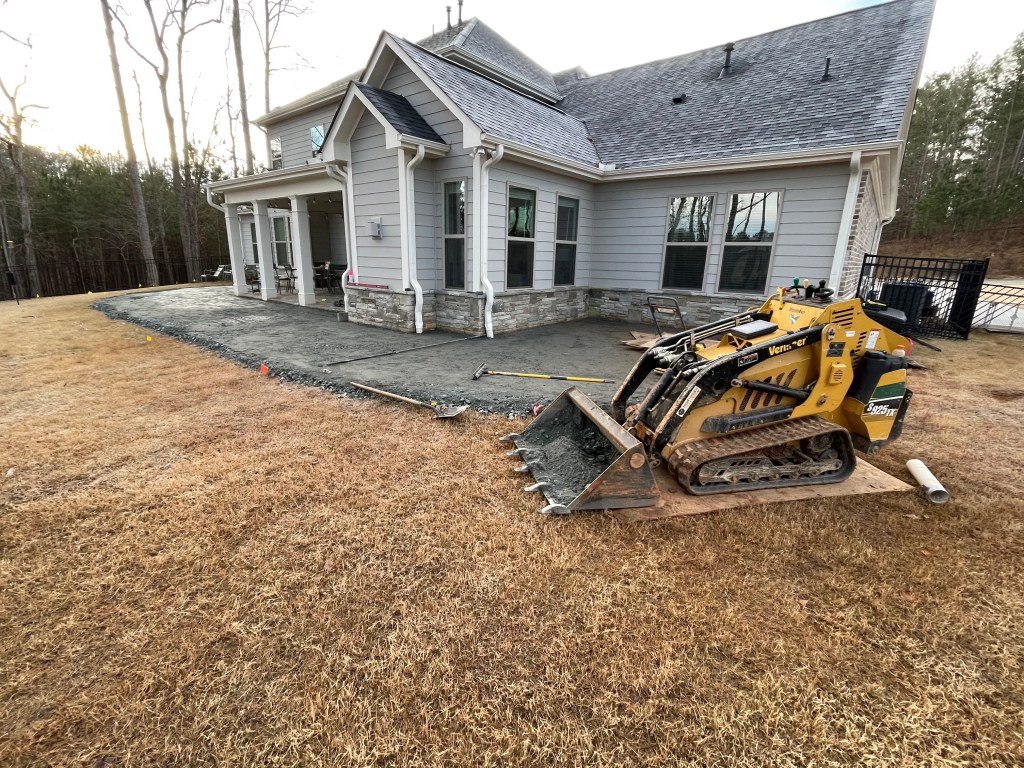
It has been a good week in the garden with the patio almost complete, just the polymeric sand to be brushed in and the grading smoothed out. A footpath will be added towards the end of the project. There will be no work in the garden today – strong winds and rain with snow forecast for later in the day. A bit more design work in the offing.

Patio almost complete.

Week 2 will involve preparation for the herb garden and herbaceous border so we have to nail down the specifics before Monday. We have always fancied a herb garden and have decided to make a raised bed to accommodate this. This idea came from our Northern Crew. The Girl on the Hudson built a small one for our grandchildren, Cob(6) and AL(3) to help them get involved with gardening. Space was limited so it ended up 4’x4’ – but so productive. Strawberries,peppers,sage,rosemary and cilantro have already been grown – and the kiddies are totally involved. There is a growing interest in worms, bugs and lizards as well as the plants themselves.

Cob with a salamander – safely released after investigation

We have no plan yet as to what we will grow but the hope is that we can get our grandaughter, Rosie (2), from the Southern Crew, as interested in plants and bugs. Our initial plan was for 3 small beds but on reflection it will be much more cost effective to go for a single bed. The available space is well defined so the size should be easy to establish. If the wind dies down a bit before the snow comes I will measure up – perhaps after coffee!

Coffee and lunch but a pause in the snow allowed us to measure 12’ x 8’ – a nice size. Constructed from 6”x 6” pressure treated timber posts, stacked 3 high,giving a bed 18” high – 4 cu yd of soil. Will see if Umberto agrees with this tomorrow!

Caterpillar Time?

One of the most simple but beautiful life cycles is that of moths and butterflies. The transformation of an egg to one of natures beauties is fascinating – no matter your age. Caterpillars in their own right are interesting ( unless they end up in your salad). The chrysalis is boring but encapsulates that moment of expectation. The emergence from the chrysalis is really exciting. The adult – just truly stunning.

Caterpillar in CP’s salad – less than beautiful!

So it is with a garden project – you go through similar emotions depending on which stage of the evolution. We are now in the caterpillar stage re the patio expansion – a bit interesting but progress seems slow. The irrigation issue has been problem solved but on the positive side it forced us to tackle and agree the irrigation strategy – so that box is ticked. 3 days in and we can see the outline of the patio which vindicates CP’s desire to limit its size. This patio is going to be big enough.

Patio foundation in place

Whilst the patio installation is following its own schedule other things have also been progressing. The ”soil” for the perennial garden has been decided upon and ordered for delivery in about 8 days time – Matt and the installation team are happy with that timing. Michael and myself have been working on the perennial plant list so the detailed schematic of planting positions can be initiated. Fortunately one of the doyens of perennial plants, Allan Armitage, lives in Georgia and he references in his 1000 + page book , how a plant looks in his garden – very helpful!

So interesting stuff taking place!

A great resource when planning a garden.

The dingo hits the soil (clay)!

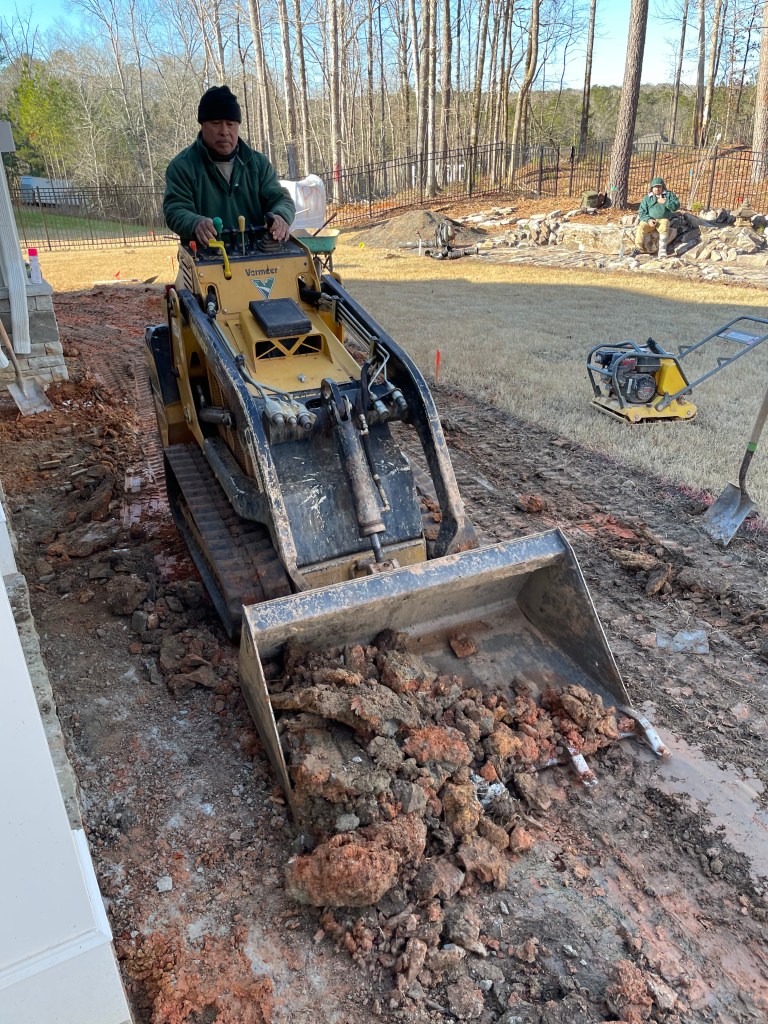
A bright winters morning, Monday 10th January 2022 and we are about to start. This is where the rubber hits the road or more accurately the dingo hits the clay!

The Dingo! Preparing the base for the patio.

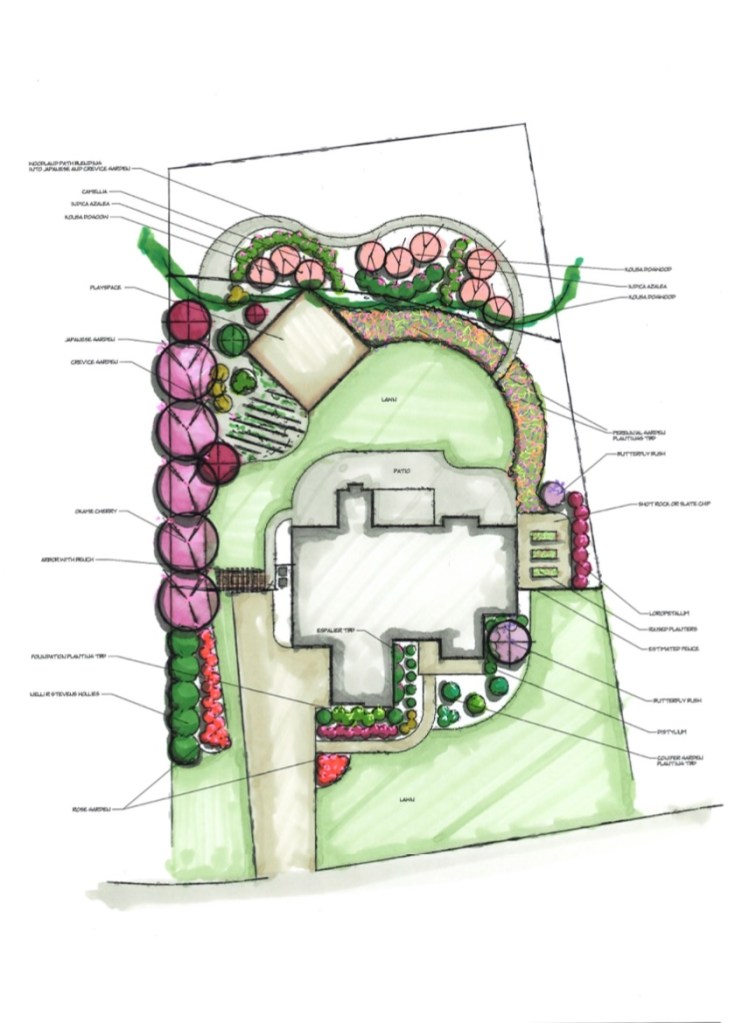
The months of discussions,reflections,changing of minds,staking out possible planting areas…..has resulted in a high level design schematic that the installation team will use to guide their work.The first action of the day is for Michael and myself to walk the garden with the Matt,the installation manager,and Umberto the project lead to review the design schematic.

Essentially we are validating the design, outlining the changes that have already been decided upon and discussing any immediate issues that become apparent. Some changes have been made to simplify and reduce cost others to enhance the aesthetics of the planting. This process takes us a little over an hour – which is a reflection of the work that has been done leading up to this point.

The design schematic – the basis for the installation.

The keys elements of the project include extending the patio;creating a raised bed for a herb garden; creating and planting a large herbaceous border; the crevice garden; the “Japanese stylistic” area; the woodland walk with associated planting; rationalising and reusing the plants installed as part of the house build.

The patio preparation is the starting point.Michael provides the specific measurements and this translates into a an outline profile on the turf. A concept I used in my professional life was value engineering so CP and myself had previously value engineered the patio – which resulted in it being made smaller, based on its intended use. So once the profile was visible CP and myself agreed that this change was what we wanted and then the team started digging it out.

As with any and every project problems will arise. A given – and day 1 was no exception. The irrigation technician needs to be consulted earlier than anticipated regarding modifications to the existing system – something that was identified in discussions but the hope being that it would be at the back end of the project.

Satisfying. We have started and AndAllen is about to become a reality. How will it shape up? Time will tell.

Camellia sinensis

It is a cold,wet,dank day in early January – a grey day – and I am so pleased that C.sinensis is part of our lives and is available to cheer us up. I have never grown this worthy plant but really appreciate the way it gives itself up to enhance our lives. Not your showy, evergreen shrub beautifully adorned with red , pink or white flowers like Camellia sasanqua , but a lesser variety…… but with the magical ability for its leaves to be brewed into tea!

Some of my earliest memories involve tea – my mum, Irene ( Renee to her friends) loved tea – a puritan drinking it black without sugar. This is something I did not try until my 60’s but now am converted – you can really taste the flavors more clearly. At home, Irene used to get tea delivered by Ringtons – they came around the community delivering bags of loose tea. Their van was black and yellow and would come every couple of weeks. As I vaguely remember they offered tea in red, green and brown packs – I never knew the difference between the blends but Irene bought the brown pack. Thinking this was a service of the past,I searched Ringtons and to my delight not only do they still operate but they still do a door service from their mobile vans. Brilliant – long may it last!

Our favorite blend

CP’s family were even more vested in tea as Allen made his career in the tea business , working for Thompson Brothers for most of his life. Punjana is their brand and for years has been our favorite tea. We are able to get a good supply and fortunately it is available in big bags! It has a lovely warm mid brown color and a mild but slightly nutty flavor.Maybe it is family loyalty, maybe nostalgia- but a steaming hot cup of Punjana on a grey day lifts the spirits.

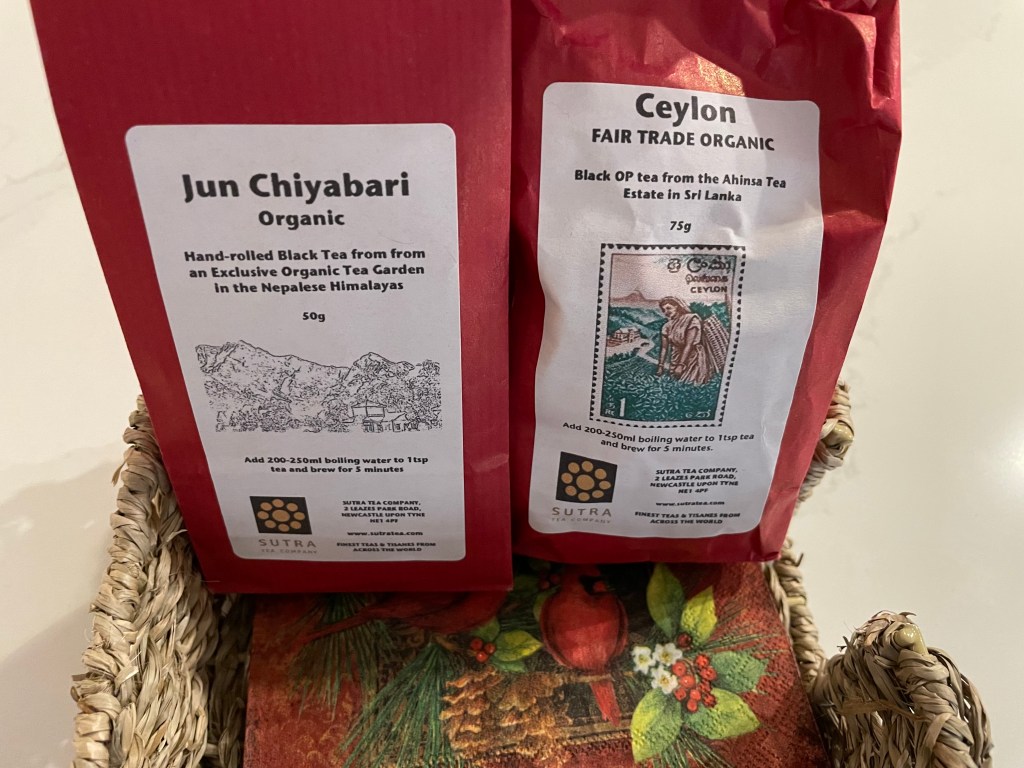
Tea varieties almost unlimited – gifts from Jen and Phil

Tea culture in the US is very different and can be a disappointment. On arriving at my office when I came here to work I was shocked that there was no kettle in the “rec room.”. What purported to be tea was brewed using hot water from the coffee machine so that once it had been steeped it was tepid. Over time (about 3 days) a kettle had been procured, tested and commissioned and users of the ”rec room” advised of its operation and the associated hazards. It took a little longer to find a reputable brand of tea but thereafter all was well with the world.

Ordering tea in restaurants can be a hit and miss affair. Once when Allen and Jean were visiting we did a road trip to Williamsburg ,Virginia and stopped at a well known chain restaurant – serve wonderful food – but they fell down on the tea front. After several failed attempts, with undrunk mugs of tepid,fawn liquid strewing the table we had established that they did not have tea pots or a kettle in the kitchen and chef would not boil water up in a pan to assist our quest for tea. Allen was denied his cuppa and refused steadfastly to have a cup of coffee. A disappointment but a memory refreshed frequently.

Phil and Jen are our family tea aficionado’s frequenting a specialist tea emporium – this year we were the beneficiaries of their passion with 2 very different teas arriving by reindeer. Both tasted and delicious – the chiyabari best suited for spring days on the patio, the Ceylon , sophisticated to be kept for those special occasions when it can be drunk uninterupted.

This Spring, I will be planting Camellia sasanqua in our woodland garden – in honor of this wonderful genus.

The 48’ measuring tape

RollsRoyceGuy doesn’t know an awful lot about plants or gardening – in fact I would go so far as to say he lives his life, as much as he can, to avoid soil. He does however know a lot about an awful lot of other things and like gardeners, he does like to get his hands dirty. He is a fixer – and I would go as far to say that there are not many things on the planet he could not fix – including old cars.

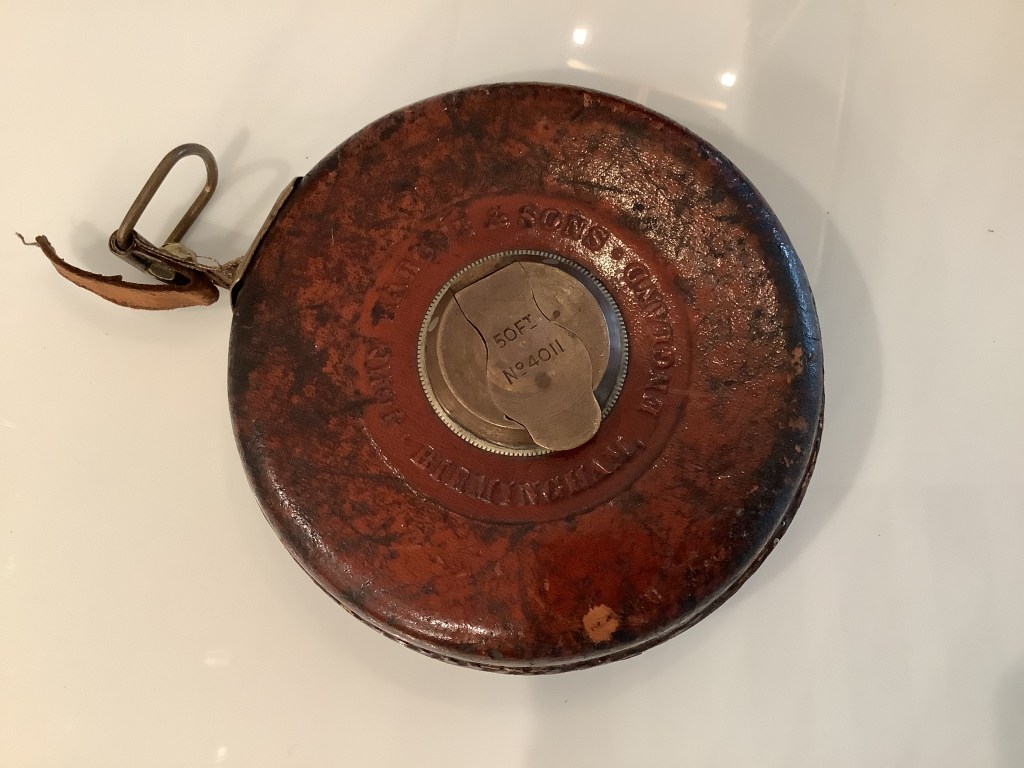
So when I came across my dad’s old measuring tape which was tatty and had a disconnected brass measuring hook, I knew a man who could help. Andy’s tape was a leather cased, 50 foot John Rabone and Son (Birmingham) rewindable tape with a brass winder.It is model # 4011 and comes in 33’,50’,66’ and 100’ options – this 50’ was probably from the late 40’s/ early 50’s. Rabone was a specialist tool maker which went through a number of mergers and acquisitions and was eventually subsumed by Stanley tools.

The 48’ measuring tape.

Now this tape was in poor condition and had a value of about $15 but in my eyes was priceless. I knew it was in need of surgery as the business end was badly shredded. RollsRoyceGuy did a great job, it is now usable, but it is only a 48’ tape – unique!

Now when you are building a new garden having a long tape is useful. The crevice garden is about 35’ by 15’ and to estimate the amount of growth medium needed requires a bit of maths, including the length and width. Some people take garden measurements by striding out. My preferred method was boot lengths – my boot measuring 14” – hence the simple calculation of ( # boot lengths x14/12) gave the required length in feet! (nice pun?).

But having a more accurate way of measuring is not the point. The feel of the leather case in my hand, the smooth action of the brass winder still perfect after 70 or so years, the fibre tape impregnated with coal dust, knowing it had accompanied Andy 1000’s of times down the Morrison Busty mine shaft – the satisfaction of working with the same tool that my dad had used.

This is just one example of the simple pleasures that gardening gives you every day – 10 minutes of weeding, refreshing a bed – seeing the first hummer of the summer – a notocactus in flower – seeing your first mayapple.All so satisfying.

I suspect that RollsRoyceGuy got as much satisfaction from fixing the 48’ tape as I get from using it.

Vegetables and Soup

Andy had his pigeons and vegetable garden.

My father in law, Allen, had roses and his vegetable garden. He was a serious rose grower, winning some very prestigious rose shows. You knew when a show was imminent as little conical caps would be placed over potential show blooms. With roses came the art of pruning which I am pleased to say he shared with me. First, the secateurs, the tools – he preferred “by- pass” action rather than anvil, and promoted spending a bit of money on them as they would then last a life time. Second came courage – do not be afraid to be bold and prune hard. Strong plants come from hard pruning. Thirdly – know your plant, when and where to prune could be different. For roses it was a light prune in the fall and a hard prune in the spring.

New garden – new secateurs – courtesy of Santa!

Anyway, back to vegetables – Allen was quite a sophisticated grower. As well as a productive plot, he also had a greenhouse and ( uncommonly for the time) was the proud owner of a chest freezer! The greenhouse allowed him to grow things like tomatoes,courgettes,cucumbers whilst the freezer helped him accommodate crops which tended to mature en masse – peas, runner beans and the like. CP often remarked that the timing of family holidays was such so as not to clash with vegetable harvests. Another predictable event was that when you sat down to Christmas lunch Allen would take great pride in letting you know which veg had been home grown – a pleasure shared by the whole family. He truly was a serious gardener.

Allens connection with his vegetables did not stop at harvesting – he enjoyed making soup. His signature was chunky vegetable. It was a process – the knife sharpened with a steel, the veg precisely cubed with a curated selection giving a colorful offering of green,orange yellow and white. CP claims that this is still her favorite soup – as opposed to my quick make blended soups!

Todays offering – roast pepper and tomato.

The design process.

Designing and building a new garden from scratch is a bit of a daunting process. I have done it before at the last house we owned in the UK before coming to the US. However the scale there was much smaller than AndAllen and I was familiar with the environment, growing conditions and contractor situation. Also I was 20 years younger! In that garden I did the design and subcontracted out the hardscaping and turf installation. Most of the planting was done by myself over a 3 month period – something that was very manageable.

February 2021- the start of the design process


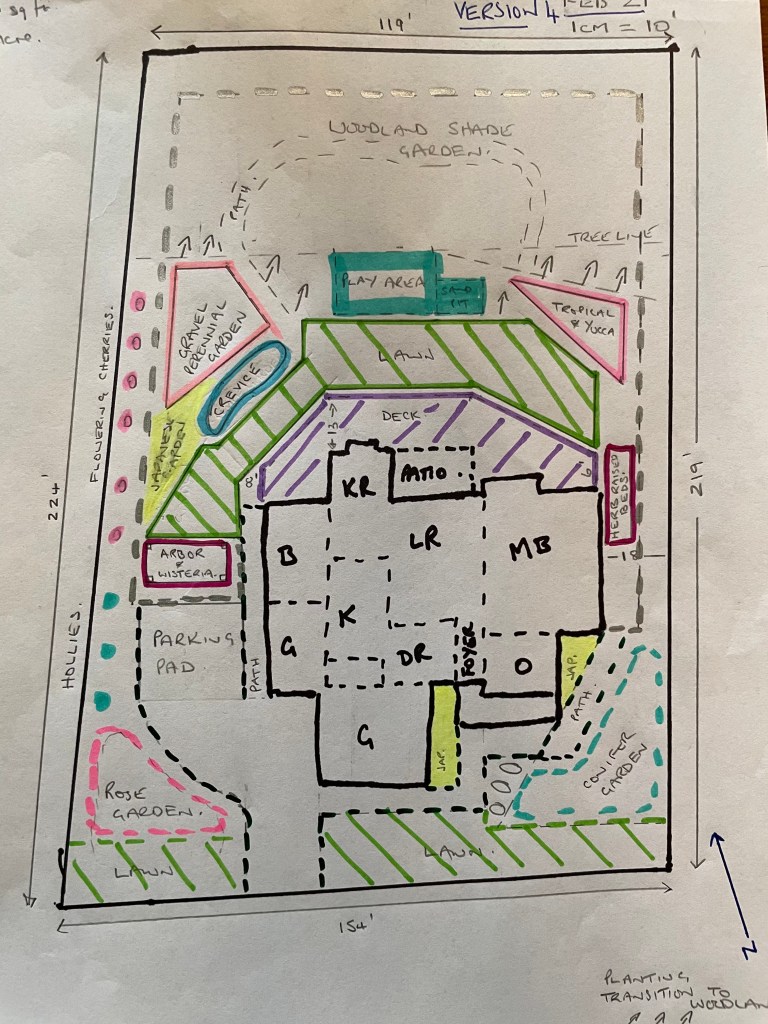
AndAllen is a different challenge and very quickly I realised I needed professional support both for the masterplan and the installation. By the very nature of the project much of the detailed design decisions would be taken on the ground during implementation. We had the skeleton of what we wanted to achieve – crevice garden, herbaceous perennials, woodland walk etc but were uncertain of the flow. After a review of the landscape design service offerings in this area we engaged with Michael Gregory.

One of the many schematics used to produce the design masterplan


This decision immediately yielded many positive benefits.Michael immediately pointed out (in hindsight) the obvious – we were trying to incorporate too many themes.This would have resulted in a ”bitty” garden that probably would have been less than satisfying. Additionally, Michael convinced us of the importance of the grass lawn in pulling the garden together and its design should not be a subsidiary activity. After an iterative process, we settled on a high level design that we were happy with and took to the HOA for approval. In parallel,Michael arranged for the preparation for the crevice garden – a really smooth and professional execution.

So here we are – the end of 2021. The major activity starts in January 2022 so there is much anticipation!